


Personal safety charity, since 1986

Everyone deserves to live life safe.

We run the free National Stalking Helpline, train organisations to protect their people, and campaign for laws that keep victims of stalking and harassment safe.

National Stalking Helpline

You are not alone. We are here for you.

Call free0808 802 0300
Monday and Wednesday
9.30am to 8pm
Tuesday, Thursday, Friday
9.30am to 4pm

Closed at weekends and on bank holidays. Free from landlines and from mobiles on all major networks. Calls do not show on BT landline bills.

In danger now? Call 999. The helpline is not an emergency service.

Get support

Stalking is never your fault.

Stalking is a pattern of repeated, unwanted behaviour that causes you to feel distressed or scared. It can happen with or without threats of violence, and it is still stalking if you know the person. You should not have to live with it.

Need to leave this page fast? Press Quick exit at the top of the screen to go straight to BBC News.

Four signs of stalking

  1. FixatedThey are fixated on getting your attention by any means.
  2. ObsessiveContact carries on even when you don’t reply, or ask them to stop.
  3. UnwantedThey contact you in person, online, or by calls and texts, when you don’t want them to.
  4. RepeatedA pattern that goes on over time, not a one-off incident.

How the helpline helps

  • Advice for your situation

    A helpline advisor will listen, then give you practical advice on risk, safety planning and the law. You decide what happens next, and you never have to answer a question that feels too personal.

  • An advocate on your side

    If you are offered advocacy, an advocate can push for the police to investigate, plan with you to keep you safe, speak up for you with the police, housing or your employer and, depending on where you live, go to court with you.

  • Help for the people around you

    Friends, family and professionals can contact us too. If you are supporting a client, refer them for advice or advocacy.

I instantly felt better as I was believed. I didn’t feel judged for getting involved with this character. I was given positive things that I could do to gather the information needed. And what to do with the information.

Someone supported by the National Stalking Helpline

In 2024 we supported 22,372 victims of stalking. Of the people we helped:

  • 98%had a clearer idea of their next steps
  • 97%reported better health and wellbeing
  • 96%were satisfied with the service

Source: Suzy Lamplugh Trust Impact Report 2024

Training for organisations

Safety is everyone’s business.

Suzy was a lone worker who went to meet a client. Forty years on, we help employers protect the people who work for them, with practical, expert-led training in personal safety, lone working, de-escalation and stalking awareness.

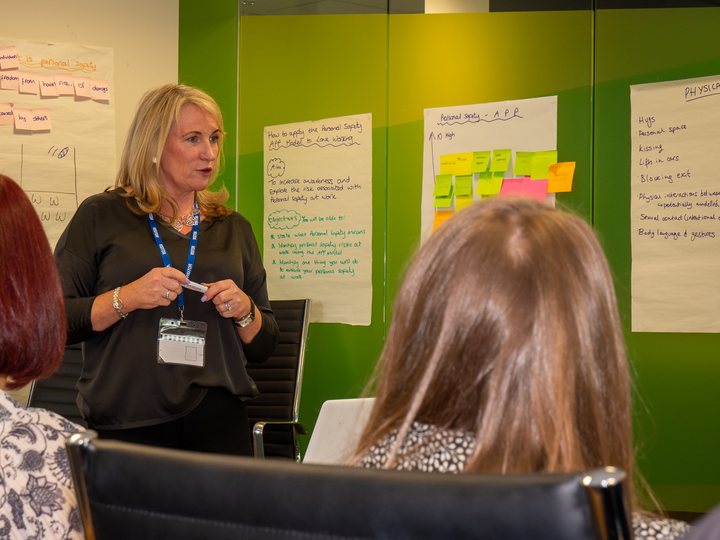
A Suzy Lamplugh Trust trainer leading a personal safety course, with notes on the walls and delegates around the table

The law now expects prevention

Since October 2024, employers have had a legal duty to take reasonable steps to prevent sexual harassment of their staff. New protections from sexual harassment by third parties, such as customers, came into force on 30 October 2026.

Our Worker Protection Act training, delivered with Blake Morgan, helps you meet the duty.

  • 16,700+people trained in personal safety and stalking awareness in 2024
  • 90%rated our personal safety courses excellent
  • 93%said they would do something differently as a result
  • 3,000+organisations worked with in the last decade

Source: Suzy Lamplugh Trust Impact Report 2024

We’ve used Suzy Lamplugh Trust for over 10 years now and have found them to be exceptional. The training is always excellent, relevant and exactly what we need. The trainer really takes time and effort to tailor all training to the individuals present and their roles.

Octavia Housing

Training clients quoted on our site include Octavia Housing Mount Anvil University for the Creative Arts Royal Borough of Kensington and Chelsea AXA

Suzy Lamplugh, smiling, in a colour portrait photograph
Suzy Lamplugh
Paul and Diana Lamplugh, smiling at each other outdoors
Paul and Diana Lamplugh

Our story

Because what happened to Suzy must not happen to anyone else.

On 28 July 1986, Suzy Lamplugh, a 25-year-old estate agent, left her office in Fulham to show a client round a house. She never came home. Within months, her parents, Paul and Diana, founded the Trust to help people be, and feel, safer.

Forty years on, we are the UK’s pioneering personal safety charity and a leading authority on stalking. Our campaigning has helped bring in the laws that protect people today.

Read Suzy’s story
  1. 1986Paul and Diana Lamplugh found the Trust.
  2. 1997The Protection from Harassment Act becomes law.
  3. 2010We open the National Stalking Helpline.
  4. 2012The Protection of Freedoms Act makes stalking a specific offence.
  5. 2020Stalking Protection Orders come into effect.
  6. 2024Investigators find clear evidence for our super-complaint on police responses to stalking, and make 29 recommendations.
  • 100,000+victims of stalking supported by the National Stalking Helpline and Advocacy Service since 2010
  • 1 million+professionals and members of the public trained
  • 40years working so that people are safer, and feel safer

Get involved

Forty years should have been enough.

Enough to stop stalking. Enough to stop harassment. Enough to stop abuse.

On 28 July 2026 we marked 40 years since Suzy disappeared. Yet every day, people still live in fear. Together, we can help ensure that one day, forty years really will have been enough.

  • Donate

    We rely on donations to fund our work, including the National Stalking Helpline. A one-off gift or a monthly donation helps protect victims and challenge violence against women and girls.

    Donate now
  • Fundraise

    Plan an event or pick from our A to Z of fundraising ideas. Every penny helps us support victims of stalking, develop training and campaign to change the law.

    Ways to fundraise
  • Add your voice

    Sign our petition calling on parliamentarians to put stalking, harassment and personal safety back on the government agenda.

    The 40 years campaign
  • Partner with us

    Partners such as SoloProtect, Knight Frank, Peoplesafe and Excello Law support our helpline, training and campaigns.

    Corporate partnerships

Questions

What people ask us first.

If your question is not here, call the helpline on 0808 802 0300.

What counts as stalking?

We define stalking as “a pattern of fixated and obsessive behaviour which is repeated, persistent, intrusive and causes fear of violence or engenders alarm and distress in the victim”. It can include unwanted messages, gifts and calls, damage to property, and contact online. If the behaviour is persistent, clearly unwanted and causes you fear, distress or anxiety, it is stalking.

It’s my ex. Does that still count?

Yes. About 45% of people who contact the helpline are being stalked by an ex-partner, and a further third have had some prior acquaintance with their stalker. Knowing the person does not make it your fault. It is still stalking, and it is still wrong.

Will the call show up on my phone bill?

Calls to 0808 802 0300 are free from all landlines and from mobiles on all major networks, and do not show on BT landline bills. If you use another provider, ask them whether 080880 numbers appear on your bill.

What if I can’t get through?

The helpline is a busy service, so you may not get through straight away. Please complete our online form and a helpline advisor will reply by email. If you need advice quickly, calling is best.

Is the helpline only for people in London?

No. The National Stalking Helpline gives free, practical advice to people living anywhere in the UK. If you are experiencing stalking in London, you can also ask to be referred to our London Stalking Support Service for advocacy.

Can you help if I use BSL, or English is not my first language?

Yes. BSL users can reach the helpline through a SignVideo interpreter, and our helpline video and advice leaflets are available in languages including Arabic, Bengali, Polish, Punjabi, Tamil and Urdu. See all the ways to contact us.

I’m a professional. How do I refer someone?

Use our professional referral form if you are seeking advice, or have a client who could benefit from advocacy. Every referral is reviewed for suitability, so advocacy is not guaranteed.

Do you train small organisations and freelancers?

Yes. We work with organisations of every size, from small businesses to large enterprises, and run open access courses for lone working freelancers, contractors and self-employed people.

Training enquiries

Talk to our training team.

Tell us about your people and the risks they face. We will recommend the right course, or shape one around your organisation.

Need support with stalking? Please do not use this form. Call the National Stalking Helpline on 0808 802 0300 or email the helpline.