








0151 422 8000 Discuss a project

Structural repair and heritage conservation Holding the North West together.

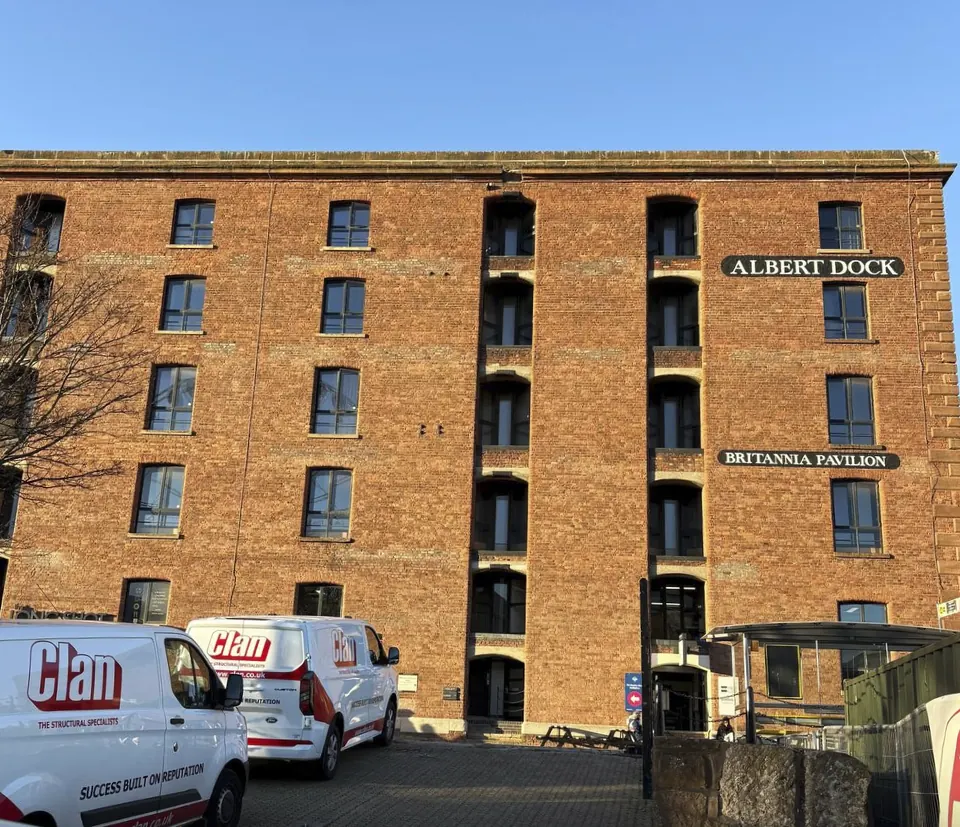
Britannia Pavilion at Liverpool’s Royal Albert Dock, a Grade I listed brick warehouse, with three Clan vans parked outside
Britannia Pavilion, Royal Albert Dock Heritage Project of the Year 2026
  1. Former signage areas repaired and repainted
  2. Our own directly employed team

From Grade I warehouses on the Royal Albert Dock to 120 occupied homes in Halton, our directly employed teams repair, strengthen and protect the North West’s structures.

  • ISO 9001 and 45001
  • CIOB chartered
  • Certified B Corp
70%
of our work comes from repeat clients
10,320+
projects delivered
100+
buildings repaired and restored
1982
founded in June, and still in the North West

Built on reputation.
The clients who keep coming back.

  • Tarmac
  • Kier
  • VINCI Construction
  • Curtins
  • Halton Housing
  • Sanctuary
  • Liverpool City Council
  • Galliford Try
  • National Museums Liverpool

Four specialisms, one directly employed team

Surface, fabric, steel and the evidence behind them.

We work as principal contractor under CDM or as specialist subcontractor to a main contractor, on occupied, listed and live sites.

A Clan operative on a scaffold trowelling repair mortar onto the edge of a concrete slab

1,500+ linear metres of carbon fibre plates at Kirkby’s multi-storey car park

Repair the concrete. Strengthen what has to carry more.

We break out to sound concrete, treat the steel, reinstate with the specified mortar and protect it, and bond carbon fibre or Kevlar where an element needs extra capacity without extra weight.

  • Carbon fibre and Kevlar strengthening
  • Hand-applied mortar repair
  • Crack control
  • Protective and anti-carbonation coatings
  • Resin injection and structural grouting
See it at Kirkby’s multi-storey car park
A Clan bricklayer rebuilding brickwork from a scaffold at Hammerstone Road Depot, Gorton

120 occupied homes: wall ties, crack stitching and repointing for Halton Housing

Brick and stone, repaired to match what is already there.

We repair and restore brick, stone and masonry façades on historic and modern buildings, respecting original materials, architectural detail and the specification.

  • Masonry repairs and remedial wall ties
  • Lime mortar repointing
  • Façade retention
  • Reverse engineering and 3D scanning
  • Façade cleaning, including DOFF
See it at Halton Housing
A Clan technician working on the cathodic protection control panel fixed to the depot wall at Hammerstone Road

32 controllable cathodic protection zones in the Rylands Building, Manchester

Stop the corrosion, not just the crack it caused.

We install specified cathodic protection, corrosion inhibitors and waterproofing to manage corrosion of reinforcement and steel embedded in concrete and masonry.

  • Impressed current cathodic protection
  • Galvanic anodes
  • Surface-applied corrosion inhibitors
  • Basement, balcony and deck waterproofing
See it at the Rylands Building
Three Clan engineers in hi-vis inspecting a concrete soffit by torchlight

5 readings on an M62 bridge: cores, carbonation, cover, moisture and resistivity

Find out why it failed before anyone specifies a fix.

Targeted testing, sampling and opening-up help engineers, surveyors and estates teams understand condition and define the repair.

  • Chemical testing: carbonation and chlorides
  • Ferroscan and other NDT
  • Core and dust sampling
  • Rope-access inspection
  • Opening-up
See it at the M62 motorway bridge

Try it

What’s your building telling you?

Pick what you can see. You’ll get what it can mean, how we would approach it and where we have dealt with it before.

What can you see?
Spalled basement soffit in the Cunard Building with corroded reinforcement exposed
The Cunard Building, Liverpool

Cracked or spalling concrete

What it can mean

Reinforcement corroding as carbonation or chlorides reach it, water ingress and freeze-thaw, impact damage or a failed earlier repair.

How we approach it

Test for cover, carbonation and chlorides, break out to sound concrete, treat the steel, reinstate it and protect it with a coating.

Where we have done it

The Cunard Building, Liverpool: basement soffits, beams and columns, Grade II listed.

A vertical crack running up the brickwork where a steel column has corroded inside, Rylands Building
The Rylands Building, Manchester

Rust or cracks along a steel frame

What it can mean

A steel frame corroding behind the masonry and pushing it apart, sometimes called Regent Street Disease.

How we approach it

Investigation first. Where it suits, cathodic protection controls the corrosion without taking down sound masonry.

Where we have done it

The Rylands Building and the Midland Hotel, Manchester, both Grade II listed.

A horizontal crack along a mortar joint in the brickwork of a house in Halton
Halton Housing, Cheshire

Bulging or cracked brickwork

What it can mean

Corroded, missing or failing wall ties, restraints or lintels, movement, or open and eroded mortar joints.

How we approach it

Survey property by property, then wall ties, crack stitching, local rebuilding and repointing in a compatible mortar.

Where we have done it

120 occupied homes for Halton Housing, and Britannia Pavilion at Royal Albert Dock.

A walkway finished with a new grey trafficable waterproofing coating
A finished trafficable waterproofing system

Water in a basement or balcony

What it can mean

Water finding a way through below-ground walls, balconies, walkways, cracks or joints, often carrying salts with it.

How we approach it

Survey the water paths, then tanking, a sheet membrane or a trafficable waterproofing system suited to the substrate.

Where we have done it

Cotton Exchange Building basement, Liverpool, and balconies in Chester for Sanctuary.

A Clan operative cleaning masonry with superheated steam at Hammerstone Road Depot
Hammerstone Road Depot, Gorton

Soiling, paint or graffiti

What it can mean

Dirt, old paint, biological growth or graffiti that the wrong method would damage along with the surface.

How we approach it

A cleaning trial first, then steam, superheated water, controlled abrasive or chemical cleaning matched to the surface.

Where we have done it

DOFF cleaning at Hammerstone Road Depot, and anti-graffiti coatings on a rail bridge for Tarmac.

A printed replica profile held up against the original historic detail at Royal Albert Dock
Royal Albert Dock, Liverpool

A missing historic part

What it can mean

A damaged, missing or obsolete architectural component nobody makes any more.

How we approach it

3D scanning and digital modelling of a sound original, so a matching replacement can be made.

Where we have done it

Original cast iron cover plates at Royal Albert Dock, scanned on site.

Carbon fibre plates bonded across the underside of a concrete deck
Carbon fibre plates on a concrete deck

It needs to carry more

What it can mean

Changed loads, an alteration or continued use that asks more of an element than it was built for.

How we approach it

Bonded carbon fibre or Kevlar adds capacity with very little weight or depth, to the engineer’s design.

Where we have done it

More than 1,500 linear metres of carbon fibre plates at Kirkby’s multi-storey car park.

Similar defects can have different causes, so investigation confirms the cause before a repair is specified.

Send us photos of this

Selected projects

From the Royal Albert Dock to the M62.

Pick a place to see what we have done there. We work across North West England and Wales from our head office in Widnes.

Map: Office for National Statistics boundaries, Open Government Licence v3.0. Contains OS data © Crown copyright and database right 2022.

Liverpool The waterfront and the commercial district

Royal Albert Dock warehouses across the water, with scaffold on Britannia Pavilion

Britannia Pavilion, Royal Albert Dock

Grade I listed. Bulging brickwork rebuilt in 100% reclaimed bricks matched to the original Victorian size, colour and patina, with tenant access kept open.

Heritage
  • A handheld 3D scanner capturing an original cast iron cover plate at Royal Albert Dock

    Royal Albert Dock cover plates

    An original cast iron cover plate 3D scanned on site and modelled so matching replacements could be made.

  • The Cunard Building on Liverpool’s waterfront, with the Royal Liver Building beside it

    The Cunard Building

    Grade II listed. Basement concrete repairs, Sika CarboDur carbon fibre strengthening, corrosion inhibition and a coating against carbonation.

  • The stone entrance of the Cotton Exchange Building, Liverpool

    Cotton Exchange Building

    Grade II listed. Basement tanking and a Fosroc Proofex 3000 membrane against groundwater and salts.

Manchester City centre landmarks, a university and a council depot

A group in hard hats inside the Rylands Building while Clan explains the cathodic protection installation

Rylands Building

Grade II listed. A 32-zone impressed current cathodic protection system for the steel frame, ground floor to Level 8.

Heritage
  • The terracotta façade of the Midland Hotel, Manchester

    Midland Hotel

    Grade II listed. Impressed current cathodic protection for embedded steel, planned to keep its visual impact to a minimum.

  • Clan operatives repairing a concrete soffit in the Zochonis Building, University of Manchester

    Zochonis Building, University of Manchester

    Floor-by-floor concrete soffit repairs while the building stayed in use.

  • Two Clan supervisors under the glazed roof of the Hammerstone Road Depot locomotive shed

    Hammerstone Road Depot, Gorton

    Shot blasting, a remotely monitored cathodic protection system and new openings in a historic locomotive shed, for Morgan Sindall.

  • A concrete slab opened up from below during an intrusive investigation in Manchester

    Commercial store, city centre

    Intrusive slab investigation on night shifts: cores, cover checks and strength testing for the engineer.

St Helens Cannington Shaw

New steel roof trusses fanning over the No. 7 Bottle Shop at Cannington Shaw

No. 7 Bottle Shop, Cannington Shaw

Grade II listed and a Scheduled Monument. Phase 1 and Phase 2 stabilisation in lime mortar, crack stitching, cast iron treatment and new steel roof trusses.

Heritage

Widnes and Halton Home: our head office is on Waterloo Road, Widnes

A three-storey block of homes in Halton with balconies, under a blue sky

Halton Housing

Wall ties, crack stitching and repointing across 120 occupied homes, surveyed property by property.

Social housing
  • A Clan operative on a tower scaffold repairing concrete at Oakfield Primary School, Widnes

    Oakfield Primary School

    Concrete repairs and protective coatings in two phases, timed for successive summer holidays.

Kirkby Knowsley

Clan operatives at work across a deck of Kirkby’s multi-storey car park

Kirkby’s multi-storey car park

NDT-led concrete repairs and more than 1,500 linear metres of Sika carbon fibre plates for heavy vehicle loads.

Infrastructure

Chester Wellington Place, Orchard Court and Willow Grove

Clan operatives on tower scaffolds outside a residential block in Chester

Three residential blocks for Sanctuary

Concrete and soffit repairs, new slab reinforcement and steelwork, and Sikafloor Pronto RB-28 balcony waterproofing. Ongoing.

Social housing

Blackpool A live hospital site

A long multi-storey ward block at Blackpool Victoria Hospital

Blackpool Victoria Hospital

Rope-access inspection to map defects at height, then Fosroc Renderoc repairs and protective coatings.

Healthcare

Rail and motorway Bridges across the region

Clan operatives in orange rail hi-vis working under floodlights on a railway bridge at night

Rail bridges for Tarmac

A seven-year maintenance contract: new steel beams for the 130-year-old Mineral Road Rail Bridge, and resin injection inside a night rail possession.

Infrastructure
  • A Clan van and an access platform under an M62 motorway bridge at night

    M62 motorway bridge

    Cores, dust samples, carbonation, cover, moisture and resistivity readings to inform maintenance.

Cathodic protection

The steel you never see.

Many North West landmarks hide a steel frame inside their masonry. When it rusts it expands, cracks the stone around it and comes back after every patch repair.

Cathodic protection treats the cause from inside the wall: a small, controlled current that stops the steel corroding, with nothing new to see on the façade.

Inside the Rylands Building, Manchester: brick around a steel column opened up for the cathodic protection anodes
Rylands Building: brick opened around a column for the anodes
32
controllable zones
9
floors of steel frame, ground to Level 8
II
Grade II listed, monitored remotely through AchillesICP
Illustration of a stone façade that peels back to show the steel frame inside, its anodes and 32 cathodic protection zones12345678910111213141516171819202122232425262728293031321234
  1. 1 Rusting steel frame behind the stone
  2. 2 Anodes set in the mortar joints
  3. 3 32 controllable zones
  4. 4 Remote monitoring unit

Illustration: a stone-clad steel frame divided into 32 zones, as at the Rylands Building. Not the real layout.

  • The terracotta façade of the Midland Hotel, Manchester

    Midland Hotel, Manchester Impressed current CP for embedded steel, planned to keep its visual impact to a minimum.

  • The cathodic protection control panel on the wall at Hammerstone Road Depot

    Hammerstone Road Depot, Gorton A remotely monitored system on the steel frame of a historic locomotive shed, with C-Probe Systems.

  • A repaired concrete cornice above brickwork at St Peter, St Paul and St Philomena Church, New Brighton

    St Peter, St Paul and St Philomena, New Brighton Cornice repairs with galvanic protection against coastal corrosion.

No. 7 Bottle Shop at Cannington Shaw, St Helens, from the air: the brick cone of the glass furnace ringed with scaffold among autumn trees
No. 7 Bottle Shop, Cannington Shaw, St Helens

Heritage stabilisation

A Scheduled Monument, held together.

One of the world’s earliest successful regenerative glass furnaces: Grade II listed, a Scheduled Monument, and at Priority A on Historic England’s Heritage at Risk register when the work began.

  • Phase 1 and Phase 2 stabilisation for Cannington Shaw Preservation Trust
  • Lime mortar repairs, crack stitching and careful rebuilding of unstable brick
  • Cast iron cleaned and protected, tunnels propped, new steel roof trusses
  • Heritage Skills Academy apprentices learning on a live monument

The aim was managed ruin status with safe public access. Our completed scope supported Historic England’s decision to review the site’s Priority A status.

A business with a heart, since 1982

From a coronation column to a Grade I warehouse.

“A business with a heart.” That’s what people say about us, and it is what we work for every day. A few of the jobs and decisions that made Clan.

  1. A Clan van and access platform at the Queen Elizabeth Coronation Column

    1982

    The beginning

    Founded in June, when structural repair was still an emerging specialism.

  2. A restored gallery room with a vaulted roof light at the Lady Lever Art Gallery, Port Sunlight

    2015

    Lady Lever Art Gallery

    Stonework, original vaulted ceilings and historic doorways, with National Museums Liverpool and Purcell.

  3. Operatives removing seats in the Main Stand at Anfield

    2016

    Anfield Main Stand

    8,000 seats removed and Execution Class 3 steel installed in 21 weeks.

  4. Clan’s three directors together at a celebration

    2019

    Built from within

    Damian Meyers, Colin McEllin and Jen Gavin, long part of the business, take it on.

  5. A repaired concrete cornice above brickwork at St Peter, St Paul and St Philomena Church, New Brighton

    2020

    Into cathodic protection

    Galvanic protection and cornice repairs at a coastal church in New Brighton.

  6. No. 7 Bottle Shop at Cannington Shaw under scaffold, from the air

    2024

    No. 7 Bottle Shop

    A Grade II listed Scheduled Monument, conserved in lime mortar and iron.

  7. The Clan site team in hi-vis at Royal Albert Dock

    2025

    Britannia Pavilion

    Grade I brickwork and ironwork on Liverpool’s busiest waterfront, tenants open throughout.

  8. Clan’s Certified B Corporation plaque on a timber stand

    2026

    Certified B Corp

    Measured against social, environmental and governance standards, and certified.

Our people

The clan behind the repairs.

Our site operatives are directly employed and trained for the work, from working at height to applying each manufacturer’s repair products.

  • Damian Meyers FCIOB, Managing Director

    Damian Meyers FCIOB

    Managing Director

  • Colin McEllin MCIOB, Operations Director

    Colin McEllin MCIOB

    Operations Director

  • Jennifer Gavin, Finance Director

    Jennifer Gavin

    Finance Director

Clan’s site team in hi-vis in front of the scaffolded brick bottle kiln at Cannington Shaw
The site team at Cannington Shaw
  • Aaron Hancock MCIOB, Commercial Manager

    Aaron Hancock MCIOB

    Commercial Manager

  • Michael Kinsella, Contracts Supervisor

    Michael Kinsella

    Contracts Supervisor

  • Sarah Wilde, Administrator

    Sarah Wilde

    Administrator

  • Lucas Gannon, Junior Project Engineer

    Lucas Gannon

    Junior Project Engineer

A Clan apprentice with the site team at Cannington Shaw, in front of the historic brick walls
On site at Cannington Shaw

Apprenticeships

Build your future with Clan.

Bricklaying, concrete repair and other specialist trades, learned on real jobs with a mentor beside you. Three apprentices worked on the Britannia Pavilion restoration.

Level 2
NVQ on completion, for bricklayers
2 years
of college, one day a week
Funded
toolkit for bricklayers, with uniform, PPE and boots
Register your interest

Social value

Community, counted.

Built by North West people, working in North West communities. We count what we give, so clients can see it.

1,437
volunteer hours
93
activities delivered
£40,288
given in cash and in kind
68%
of activity recurs every year
The Clan team in yellow Running the Railways shirts at the Centre 56 relay
£116,300 raised for Centre 56 across three Running the Railways challenges. Clan was headline sponsor in 2026.
Halton Farnworth Hornets FC celebrating as league champions in Clan-sponsored kit
Kit sponsor of Halton Farnworth Hornets FC since the under 13s
The Clan team holding Christmas hampers beside a van
Christmas hampers for Widnes Foodbank and Nightstop
The Clan team in evening dress at an awards night
Celebrating specialist excellence The Clan team on an awards night in 2026

Standards we are held to

Certified, chartered and recognised.

  • NQA ISO 9001 and ISO 45001, UKAS accredited
  • CIOB Chartered Company
  • Certified B Corporation

Four awards in 2026

  • Heritage Project of the Year Insider Liverpool City Region Property Awards, for Britannia Pavilion
  • Excellence in Construction Halton Business Awards
  • Commitment to the Community Halton Business Awards
  • Manufacture or Trade Business of the Year Merseyside Independent Business Awards

Questions

Occupied, listed or live? Ask us.

Answers to what estates teams, housing providers, engineers and conservation architects ask us first.

0151 422 8000
Should we approach Clan before we have a repair specification?

Yes. We can carry out an initial survey and help prepare a proposed repair plan. Findings that need structural assessment or design are coordinated with the appointed engineer or consultant.

Can you work while our building stays occupied?

Yes. We agree access, separation and sequencing around the people using the building, and the repair scope decides which areas need temporary restrictions. We have worked in occupied homes, schools, a university and a hospital.

Can you work to a conservation architect’s specification?

Yes. We work with conservation professionals, surveyors and engineers to deliver the agreed repair specification and coordinate material approvals and specialist interfaces.

Does every historic masonry repair need lime mortar?

No. Mortar should be compatible with the existing masonry, exposure and conservation requirements. Historic work often uses lime, but analysis, sample panels or trials may come first before the mix, colour, texture and joint profile are agreed.

What is the difference between ICCP and galvanic cathodic protection?

Impressed current cathodic protection uses an external power source to give a controllable current, normally with reference electrodes. Galvanic protection uses a more active anode material and has no powered control unit. Investigation and design decide which suits.

Does all spalled concrete need replacing?

No. The repair scope should separate unsound concrete from material that is still serviceable. Where local repair is right, hand-applied mortar reinstates the damaged area and keeps the sound concrete around it.

Can our estates team appoint you directly?

Yes. We work directly for clients or through an appointed consultant, surveyor or main contractor, from the first investigation to the agreed repair scope.

Start a project

Send us what you’ve got.

Condition reports, photographs, drawings, a conservation specification or consent conditions. Whatever you have helps us set out the investigation, repair and approvals.

Step 1 of 2: the building

What kind of building or structure is it?
What are you seeing?
Is there a repair specification yet?
Call Discuss a project