Drainage & groundworks contractor Since 1980

Good ground starts underneath.

Field and sports drainage, equestrian arenas, utilities, lakes and ponds, civil engineering and laser-screeded concrete across Norfolk, Suffolk and Essex. One family firm from Bungay, with its own machines, materials and concrete.

What needs doing?

  • 1980 started by Allan Collyer
  • 2nd generation: Chris & Colin
  • 1,000 m²+ of concrete laid to level a day
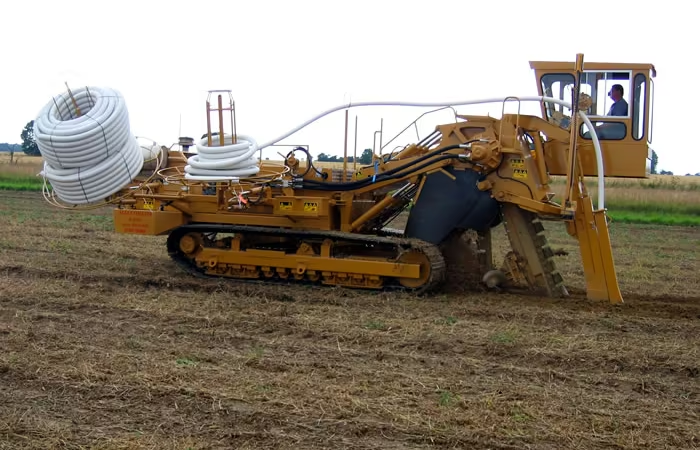
One of our tracked trenchers laying perforated land drain from the coil across a ploughed field Above ground: one of our trenchers at work
Below ground: what the trencher leaves behind Cross-section under the field: dark topsoil, subsoil, a narrow trench of permeable gravel backfill and a perforated land drain near its base. The water table dips down towards the drain as water seeps into it. Topsoil Subsoil Water table Permeable backfill Perforated land drain
Photo of our trencher at work above a drawing of the drain it lays below the surface.

Trusted for over four decades by

  • Farms & estates
  • Local authorities
  • Sports clubs & golf courses
  • Livery yards & polo arenas
  • Poultry & grain businesses
  • Natural England nature reserves

What we do

Seven trades. One team. Our own kit.

Most jobs need more than one of them. A drained field needs a clear outfall, an arena needs drainage before its surface, a poultry unit needs a level base before its floor. We do all of it ourselves, so nothing waits on another firm.

A trencher cutting a drain run through a green winter crop

Where it all began

Agricultural land drainage

From a wet corner of a paddock to a whole arable farm. We survey, design and install, using up-to-date trenchers and grading systems, and we keep a big stock of materials so even the largest scheme isn't waiting on deliveries.

  • Survey, design and installation
  • Up-to-date trenchers and grading systems
  • Any scale of job, delivered on time
More on land drainage
Newly drained playing field with the drain runs marked out across the grass

Sports field drainage

Pitches that play after rain. Primary and secondary drainage for pitches and golf courses, for councils, clubs and private owners.

  • Spoil-removal conveyors keep the turf clean
  • Wheeled machines on turf tyres
More on pitches
Our excavator, with Allan Collyer & Sons on the boom, building an arena inside new post-and-rail fencing

Equestrian arenas

From a single horse's exercise arena to commercial livery yards and all-weather polo. Planning if needed, drainage, construction, fencing and landscaping, all in house.

More on arenas
Tracked excavator on a cross-country service run, with a cable drum ready on the ground

Utilities installation

Cross-country water, electricity, gas and sewer runs, with pre- and post-drainage to suit. From a single service main to large-scale installations.

More on utilities
A finished lake with grassed banks, settled into the surrounding fields and woodland

Lakes, ponds & conservation

New lakes and ponds, and old ones brought back, shaped to the natural contours so they look like they were always there. Regular work for Natural England on national nature reserves.

More on lakes
Aerial view of a farm with poultry houses and a newly levelled building base beside them

Civil engineering

Bases for large storage and poultry buildings, including free-range and higher-welfare units. Culverts, underground tanks, and waste water containment and treatment. CAD design and laser-guided machines keep it on time and on budget.

More on civils
Our crew laying a large concrete slab with the laser screed, survey masts set up on either side

Laser concrete screeding

Over 1,000 m² laid to accurate levels in a day, then a fine finish from ride-on power floats. Outside pads, grain store and factory floors, poultry buildings.

Plan a pour
The Collyer Concrete volumetric mixer lorry in Allan Collyer & Sons livery

Sister business

Collyer Concrete & aggregates

Concrete mixed on site, so you only pay for what you lay. Thirteen aggregates, from Type 1 granite to horse arena stone.

About Collyer Concrete

Land drainage, explained

See what's going on underneath.

Most drainage problems start where you can't see them. Switch between before and after to see what a well-laid scheme does to the water in your soil.

Schematic, not to scale

Cross-section of a field before and after drainage Before drainage the water table sits just below the surface, in the root zone, with puddles on top and short, yellowing crops. After drainage three lateral drains in permeable backfill draw the water table down between them and carry the water to an outfall in the ditch, so roots go deeper and the crop is green and even. Water table: in the root zone Water table: drawn down Permeable backfill Lateral drain Outfall to ditch
Before: after rain the water sits in the root zone. Roots stay shallow, machinery sinks, and the same patches yellow every year. After: lateral drains in permeable backfill draw the water table down between them and carry it to the ditch. Roots go deeper, the ground carries machinery sooner, and the crop evens out.

Is your field telling you something?

  • Water lying in the same places after rain
  • Patchy, yellowing crop in the same spots each year
  • Ruts, and late starts on the land in spring
  • Rushes and moss creeping in
  • Old outfalls blocked, buried or running dry

Waterlogging can also be hidden, and sometimes the real problem is a compacted layer rather than missing drains. That's why we look before we quote.

Arrange a survey visit

In some years, “drainage can make the difference between having a crop to harvest and complete crop loss.”

AHDB, Field Drainage Guide

How we work

One contact, from the first visit to the final finish.

  1. We come and look

    We walk the site with you, check levels, soil and outfalls, and listen to what the ground has been doing.

  2. We design it properly

    CAD design and laser levels, so drains fall the right way, arenas shed water and pads come out flat.

  3. Our own team does the work

    Our trenchers, excavators, graders, laser screed and power floats, our stock of materials, and concrete and stone from our own yard.

  4. We finish what we start

    Fencing, landscaping and the final finish are done in house too, to the deadline and the budget we agreed.

Laser concrete screeding

1,000 m² a day, laid to level.

Our laser screed levels and compacts the concrete in one pass, so big floors go down fast and flat. Ride-on power floats then give the fine finish today's buildings need.

  • Grain stores, factory floors and poultry houses
  • Outside pads and yards, any type and thickness
  • Bases prepared by our own civils team
Close-up of the laser screed head levelling wet concrete as two of the team check it Ride-on power float finishing a new floor inside an open-sided farm building

Plan a pour

Rough out your floor or pad. We'll check the spec, joints and access on site.

1,200m² of floor 180m³ of concrete 2pour days at our pace

A guide only. Your engineer's specification sets the thickness and mix; volumes exclude wastage. Pour days assume our laser screed's 1,000 m²+ a day.

Our work

Photos from the job, not a stock library.

The Allan Collyer & Sons team in work overalls, lined up beside one of our trenchers loaded with drain pipe

Some of the team, with one of our trenchers.

  1. 1962Allan Collyer starts work for a land drainage contractor.
  2. 1980Allan starts his own drainage business near Bungay.
  3. 2003Allan Collyer & Sons Limited is formed.
  4. TodayChris and Colin run the firm, from drains to laser-screeded floors, with Collyer Concrete alongside.

The family

Started by Allan. Run by his sons. Still answering the phone.

Allan Collyer went to work for a land drainage contractor in 1962, and started his own business in 1980. His rule was simple: do the job properly and give good value for money.

His sons, Chris and Colin, run the company today, and that rule hasn't changed. Some of Allan's first customers still call us when there's work to do, which says more than any brochure could.

We're not afraid to try new kit when it does the job better. Laser-guided grading and the laser screed came in because they save our customers time and money. The pride in the work hasn't changed either.

Chris Collyer

Director

07747 600243

Colin Collyer

Director

07785 350878

Need concrete or stone? It's from the same yard.

Our sister business mixes concrete on site from a volumetric mixer: the exact amount, mixed as you need it, so you only pay for what you lay. Domestic, commercial and agricultural.

  • The mix can change on site if the job needs it
  • No over-ordering, no waste to pay to dispose of
  • Wheelbarrows carried on board, free to use
  • Full traceability, with a printout of the mix on site

Aggregates we supply

  • Type 1 granite
  • Ballast
  • Primary stone
  • Granite dust
  • Horse arena stone
  • Sharp sand
  • Building sand
  • Fill sand
  • Topsoil
  • Recycled crushed concrete
  • Crushed brick rubble
  • Crushed tarmac
  • Screened tarmac
Visit collyerconcrete.co.uk
The Collyer Concrete volumetric mixer discharging onto steel mesh for a new slab while the crew rake it out Our DAF tipper lorry in Allan Collyer & Sons livery in the yard

Where we work

Based near Bungay. Working across three counties.

Our yard is at Ilketshall St Margaret, just south of Bungay on the Suffolk side of the Waveney. Most of our work is in Norfolk, Suffolk and Essex. If your job is further afield, ask: we'll tell you straight whether we can do it well.

Yard
Pump View, Ilketshall St Margaret, Bungay NR35 1NA
Office hours
Monday to Friday, 9am to 4pm
Counties
Norfolk, Suffolk and Essex
Get directions to the yard
Map: our base near Bungay and the counties we work inNorfolk, Suffolk and Essex are highlighted. Our yard at Ilketshall St Margaret, near Bungay, sits on the Norfolk and Suffolk border, with rings at 25 and 50 miles.PeterboroughLutonMedwayBedfordCentral BedfordshireCambridgeshireHertfordshireKentLincolnshireSouthend-on-SeaThurrockEssexNorfolkSuffolkNORFOLKSUFFOLKESSEX25 miles50 milesNorwichGreat YarmouthLowestoftKing's LynnThetfordDissBury St EdmundsIpswichColchesterChelmsfordOur yard, near Bungay

Boundaries: ONS, OGL v3.0. Contains OS data © Crown copyright 2024. Town positions approximate.

Straight answers

Questions we're often asked.

Can't see yours? Ring the office on 01986 781404.

Which areas do you cover?

Mainly Norfolk, Suffolk and Essex, from our yard at Ilketshall St Margaret near Bungay. If your job is further afield, ask: we'll tell you straight whether we can do it well.

How do I know if my field needs draining?

Water lying after rain, the same patches yellowing every year, ruts and late spring starts are the usual signs. Waterlogging can also be hidden, and sometimes the real problem is a compacted layer rather than missing drains (AHDB advises sorting that first). So we look before we quote, and we'll tell you which you need.

Will you take on a small job?

Yes. We take on any scale of drainage job, from the largest arable contract to a single paddock.

Do I need permission to work on a ditch or put in a culvert?

Often, yes. Work in or around a main river needs an environmental permit from the Environment Agency. For other watercourses, including most ditches, you may need consent from your lead local flood authority (the county council) or your internal drainage board. GOV.UK says new culverts are unlikely to be allowed, because they can increase flood risk. We'll tell you up front if your scheme needs consent. Read the GOV.UK guidance.

Do I need planning permission for a horse arena?

It depends on your council and the arena: its size, the groundworks, fencing, lighting and whether it's private or commercial all count, so ask your council early. We handle every stage in house, from initial planning if it's needed, through drainage and construction, to fencing and landscaping.

How quickly can you lay a large concrete floor?

Our laser screed lays in excess of 1,000 square metres a day to accurate levels, levelling and compacting in one pass. Ride-on power floats then give the fine finish modern buildings need. Plan a pour to see roughly how many days yours would take.

Can I buy concrete or stone for my own project?

Yes, through our sister business, Collyer Concrete. Concrete is mixed on site from a volumetric mixer, so you only pay for what you lay, and we supply thirteen aggregates, from Type 1 granite and ballast to topsoil and horse arena stone. Call 01986 781404 or email concrete@collyerdrainage.co.uk.

Who will I deal with?

One point of contact from first visit to finished job, usually Chris or Colin Collyer, who run the company. Their mobile numbers are on every page of this site.

Get a quote

Tell us about the job.

A few details and a rough idea is plenty. We'll call you back to talk it through and arrange a visit.

What needs doing? Required
When?

We'll only use your details to reply about this job. Prefer to talk? Call 01986 781404.